
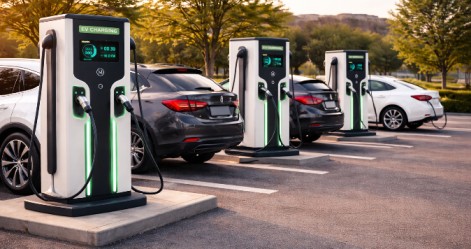

Turning Parking Lots Into Revenue: A Property Manager’s Guide To Paid EV Charging
Most parking lots earn money in one of two ways, if they earn anything at all: a monthly permit or an hourly rate. The space sits there, the car sits in it, and the asset does very little in between. Electric vehicles change that. A driver who parks for three hours while their car charges is buying something besides the space, and they expect to pay for it.
For property managers, that opens a small but real revenue line. It also opens a list of decisions that are easy to get wrong: how many chargers, which kind, what to charge, who handles payments and who gets the call when something breaks. This guide walks through those decisions in roughly the order you’ll face them.
Start with who actually parks there
Before you look at a single charger, look at your parking data. Who parks in your lot, and for how long?
An office building where tenants arrive at 9 and leave at 6 is a very different case from a retail centre where the average visit is 40 minutes, and both differ from an apartment complex where cars sit overnight. Dwell time decides almost everything else. Long stays suit slower AC chargers (often called Level 2, typically 7 to 22 kW). Short stays only make sense with DC fast charging, which costs far more to install and puts heavier demands on your electrical supply.
A common mistake is putting expensive fast chargers in a lot where people park all day. The car finishes charging in an hour, then blocks the bay for seven more. You’ve paid for speed nobody needed, and you’ve created a queue.
If you don’t have good parking data, ask your tenants. A short survey asking who drives an EV now, and who expects to in the next two years, will tell you more about your own building than any market forecast.
Check your electrical capacity early
The second conversation should be with an electrician, not a charger salesperson. Many older buildings have little spare capacity at the main panel, and a service upgrade can cost more than the chargers themselves. If the utility has to get involved, it can also take months.
There are ways around this. Dynamic load management (sometimes called load balancing) lets a group of chargers share a fixed amount of power, adjusting each one’s output so the total never goes over what your supply can handle. Ten chargers on a shared supply, each slowing down a little when the lot is busy, is often a better deal than five chargers at full power plus a large upgrade bill. Ask any installer whether the chargers they quote support it, and whether the software you plan to use can control it.
Plan for growth while you’re at it. Running conduit to 20 bays while the ground is already open for 6 costs far less than trenching the car park twice.
Decide how you want to make money
There are a few business models, and each carries a different mix of risk and reward.
The first is to own and operate everything yourself. You buy the hardware, pay for installation, set prices and keep the revenue. You get the highest margin and full control, but you also carry the upfront cost and the day-to-day work.
The second is a revenue-share or site-host deal with a charging network. A third party installs and runs the chargers, often at little or no cost to you, and pays you a share of revenue or a fixed lease. It’s simpler, but your cut is smaller, the contracts often run for many years, and you usually have less say over pricing and how drivers are treated.
The third sits in between. You own the chargers and pay for a software platform that handles billing, payments and monitoring, while you set the rules. Plenty of property owners end up here once they have a few sites and want control without building their own tech.
None of these is right for every building. A manager with one site and no appetite for operations might reasonably take the hosted deal. An owner with dozens of properties will probably want to own the asset.
Set prices that drivers will accept
Pricing is where EV paid charging succeeds or quietly fails. Charge too little and you won’t recover your electricity and hardware costs. Charge too much and drivers go elsewhere, or the bays sit empty.
Most operators use one of three methods, sometimes combined:
- Per kWh, which is the fairest to drivers because they pay for the energy they use. Check local rules first, as some places restrict who can resell electricity this way.
- Per hour or per session, which is simpler and works where kWh billing isn’t allowed.
- Idle fees, a per-minute charge that starts once a car has finished charging but is still plugged in. These are less about revenue and more about keeping bays free.
A sensible starting point is to work out your real cost per kWh, including demand charges from your utility (these can be large and are easy to overlook), then add a margin that keeps you below public fast-charging prices nearby. Look at what other sites in the area charge. Drivers check apps before they arrive, so they already know.
You can also price by user. Tenants might get a discounted rate as an amenity while visitors pay the full price. Time-of-day pricing can nudge charging into the hours when your own electricity is cheapest.
A rough example
Say you install eight Level 2 chargers in an office car park. Each one averages three sessions per weekday, delivering about 15 kWh a session. That’s 360 kWh a day, or roughly 7,900 kWh a month over 22 working days.
If electricity costs you $0.18 per kWh and you charge drivers $0.35, you keep $0.17 per kWh, or about $1,340 a month before software fees, card processing, maintenance and any lease costs. These figures are made up for illustration; yours will depend on local tariffs, usage and hardware prices. What the example shows is that the margin per session is thin, so utilisation matters far more than price. A charger used six times a day earns twice as much as one used three times a day at the same rate.
That’s also why chargers that sit broken are so expensive. A dead charger doesn’t only lose its own revenue. It teaches drivers not to rely on your site, and they don’t come back to check whether it’s been fixed.
Make paying easy
Drivers have little patience for complicated payment. If they need to download an app, create an account, confirm an email and add a card just to charge for an hour, a good share of them will drive off.
Offer more than one way to pay. Contactless card readers on the charger, a QR code that opens a web payment page, an app for regular users and RFID cards for tenants or fleet vehicles` will cover most people. If your chargers support roaming, which lets drivers pay through network apps they already use, your site also appears on more maps and picks up visitors who would never have found it otherwise.
Choose software before you choose hardware
This sounds backwards, but it saves trouble later. If you’re comparing EV charging software for property managers, keep in mind that it’s what actually runs the business. It sets prices, takes payments, shows you which chargers are earning, alerts you when one goes offline and handles load management.
Look for software that works with chargers from many manufacturers, usually through the open OCPP protocol. If your software only talks to one brand of hardware, you’re tied to that brand for every replacement and expansion. Ask how the platform handles tenant billing, payouts, reporting and remote fixes. Many faults can be cleared with a remote reset, which costs a lot less than sending a technician out.
Plan for the boring parts
Paid EV charging is a service, and services need upkeep. Someone has to answer when a driver calls at 10pm because the cable won’t unlock. Bays need clear signs and some enforcement so petrol cars don’t park in them. Cables get run over. Screens fade in the sun.
Budget for an annual maintenance contract, decide who handles driver support, and agree on a response time for faults. Read the charger warranty closely so you know what’s covered and for how long.
Incentives are worth a look too. Many governments and utilities offer grants or rebates for commercial charging, and some cover a decent share of the cost. The rules change often, so check what’s available in your region before you sign anything.
Start small and measure
You don’t need to electrify the whole car park in year one. Install a modest number of chargers, run conduit for more, and watch the data for six months. Which bays get used most? When is it busiest? Are tenants or visitors your main users? Are people leaving cars plugged in all day?
Those answers tell you whether to add chargers, change your prices or bring in idle fees. A lot that starts with four chargers and adds eight more after a year of real usage will usually do better than one that guessed at twenty on day one.
For most properties, parking has always been a cost of doing business. With some planning, part of it can start paying its own way.
