
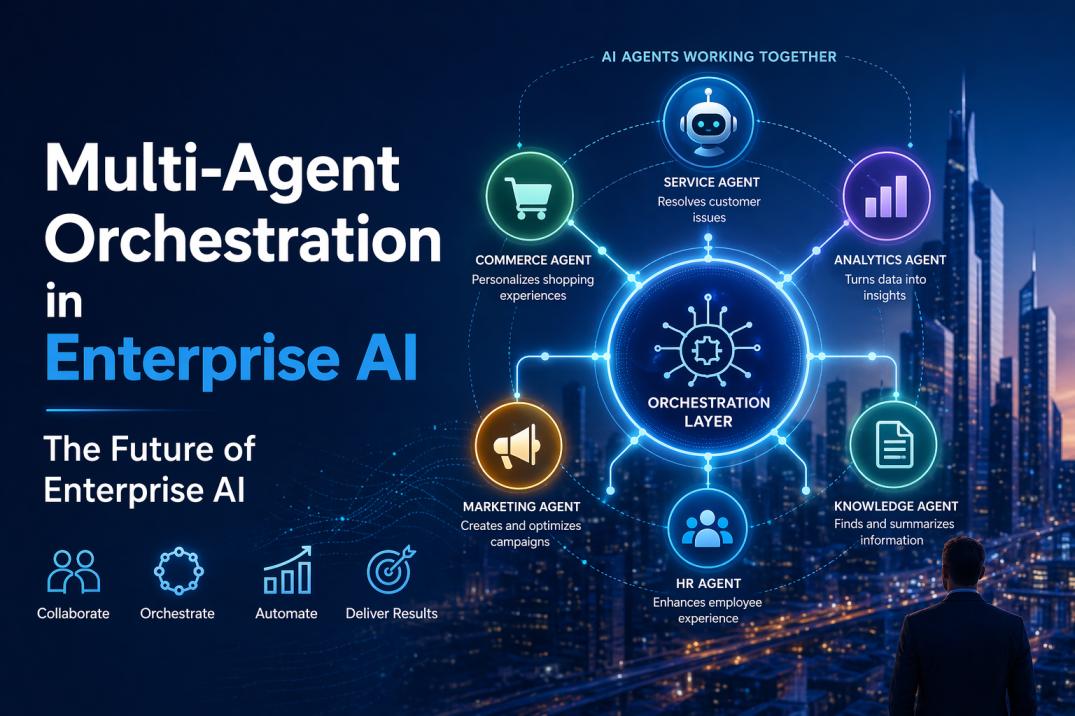

Multi-Agent Orchestration in Salesforce: The Future of Enterprise AI
The rapidly changing enterprise AI landscape is undergoing rapid transformation with organizations making a conscious shift from single-model intelligence to interconnected systems of specialized agents. Multi-agent orchestration lies at the heart of this transformation, which enables numerous AI agents to associate, interact, and run complex workflows by default. This approach is transforming the way businesses automate operations, boost client engagement, and augment decision-making. With businesses getting more inclined to draw the most out of their AI investments, multi-agent orchestration has emerged as a necessity rather than just an innovation. To ensure successful implementation, partnering with an experienced Agentforce Consulting Partner makes sense.
What is Multi-Agent Orchestration?
Traditional AI systems are developed around a single model. This is created to manage specific tasks like content generation, anticipating outcomes, or handling everyday processes. While this method works well in siloed use cases, it fails to handle complex and multi-step business workflows that call for deeper context, synchronization, and flexibility.
Multi-agent orchestration dominates these restrictions by introducing a system of expert AI agents, each responsible for distinct functions. These agents collaborate seamlessly in real time—sharing relevant information, assigning tasks, and continuously adapting based on outcomes—while leveraging salesforce ai services to enhance coordination, scalability, and intelligent decision-making.
Within a Salesforce setting, this interprets into multiple AI agents working in association with each other across CRM data, client interactions, analytics, and business workflows. This enables more connected, receptive, and smart outcomes.
Why is Salesforce the Right Platform for Multi-Agent Systems?
As a reputed name in the customer relationship management space, Salesforce acts as a cohesive platform that brings sales, service, and marketing together. With the introduction of AI-driven capabilities like Einstein and evolving automation tools, Salesforce is exceptionally positioned to support multi-agent arrangements.
Some of the key benefits include:
Unified Data Foundation: Besides providing a single source of truth for client data, Salesforce enables AI agents to function with consistent and precise data.
Workflow Automation: With tools such as Flow and Apex, businesses can rewrite complex processes that AI agents can augment and optimize.
Integration Ecosystem: Since Salesforce connects easily with third-party Apps, AI agents can easily connect across systems.
How is Multi-Agent Orchestration Influencing Enterprise AI?
It is way more than just technical augmentation. It shows a major shift in how organizations operate. By enabling several AI agents to connect in real time, organizations can address applications that were either too complex or labor-intensive to handle efficiently.
Intelligent Customer Engagement: Different agents can take over expert roles: one handles initial customer queries; another assesses sentiment and intent. However, the third one suggests tailor-made offers. Working together, these agents create a responsive, seamless, and highly tailored customer experience that won’t be easy to attain with a single AI system.
Multi-agent Orchestration: It enables decision-making by default across multiple business functions by directing expert AI agents.
Process Optimization in Real Time: AI agents can uninterruptedly track workflows and become accustomed to them in real time – enabling greater agility and receptiveness. This is especially valuable in fast-moving industries where changing conditions call for instant modifications to ensure efficiency and accuracy.
What are the Elements of Multi-Agent Orchestration in Salesforce?
To realize the potential of multi-agent orchestration, organizations must comprehend its core building blocks:
Agent Specialization: Every AI agent is created to perform a particular function including data analysis, communication, or processes. This ensures greater efficiency and precision across processes.
Communication Protocols: This layer enables agents to make hassle-free exchange of data and make intelligent choices based on real-time data.
Orchestration Layer: It sits at the core. Besides directing agent activities, it also allocates tasks, and tackles conflicts. Feedback loops allow constant learning, which allow agents to manage their performance and augment outcomes over time.
Addressing Real-life Use Cases
Optimization of Sales Pipeline: Multi-agent orchestration augments sales pipeline optimization by allowing multiple AI agents to work in association with each other. A lead scoring agent analyzes and orders prospects; an engagement agent offers customized outreach, and a forecasting agent anticipates revenue outcomes. This approach augments efficiency, augments conversion rates, and allows more precise and reliable sales forecasting.
Customer Support Automation: In client service, multi-agent orchestration simplifies processes by directing tickets, providing immediate responses, and intensifying complex issues to the appropriate agents. This collaborative approach decreases response times, optimizes efficacy, and enables quicker resolutions. This ultimately leads to augmented customer satisfaction and a better support experience.
Campaign Management: Marketing teams can make the most of AI agents to update campaign management by smartly grouping audiences, generating appropriate content, and endlessly enhancing performance in real time. This enables more niche engagement, augment engagement, and eventually leads to impactful and result-driven marketing strategies.
Significance of Generative AI in Multi-Agent Systems
Generative AI lies at the heart of multi-agent orchestration. This empowers agents to function smartly and autonomously. Besides enabling them to create tailor-made content and draw actionable insights from fragmented data, it engages users through conversational interactions. By using Generative AI, organizations can develop purpose-built agents aligned with their unique business needs. This eventually augments the overall efficiency of the system.
Why Leveraging Strategic Expertise Makes Sense?
The importance of strategic expertise becomes obvious when navigating the intricacies of multi-agent transposition. Many organizations rely on an Agentforce Consulting partner to effectually develop, implement, and refine their AI strategies. These partners bring in-depth knowledge of Salesforce architecture, hands-on experience with AI and automation along with demonstrated best practices for growth and governance. Apart from this, Agentforce Consulting Services offer detailed and end-to-end support — including everything from initial planning to deployment and constant optimization. This ensures that businesses can make the most of the value of their AI investments.
Final Words
Multi-agent orchestration isn’t just a simple technological upgrade. It represents the next wave of enterprise AI. By associating with experts, businesses can improve their functions, provide user-specific experiences, and obtain long-term growth. With its powerful platform and huge ecosystem, Salesforce offers a strong base to support this evolution. However, to make the most of its potential a clear strategy, proficiency, and a focus on constant innovation is required. As companies continue to invest in AI, organizations that stay ahead in adopting multi-agent orchestration will be better positioned to stay ahead in the ever-evolving digital transformation landscape.
